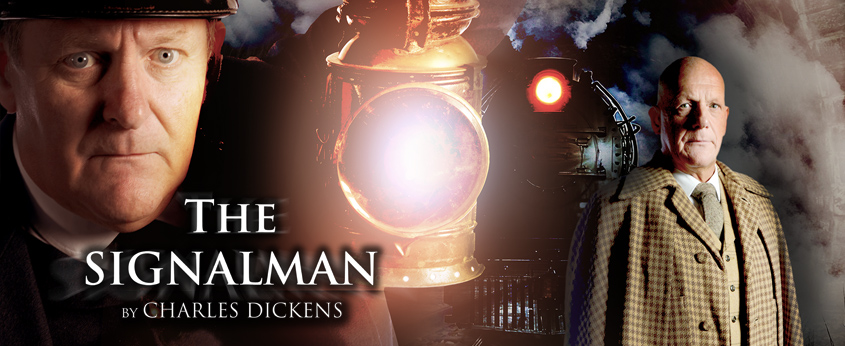
After a very quiet August, it was great to get back to work, and what better way than with a play staged within walking distance of home which ended at the civilised time of 9.20pm.
The Signalman is based on a short novel by Charles Dickens, which was part of a collection called The Mugby Junction, for the 1866 Christmas edition of All The Year Round, a literary magazine owned, published and edited by Dickens. What is it with ghost stories and Christmas?
The tale has been adapted for the stage by Francis Evelyn, who has added some extra scenes to enable the piece to be divided into two acts, the book being fewer than 30 pages long. He has also moved the action from 1866, the year it was written, to 1880. Dickens had been involved in a fatal train accident on 7th June, 1865 and it was thought that this experience led him to write the novel. The adaptor’s article in the programme makes no mention of why the year was changed. If there was any significance it escaped me.
The story centres on the Signalman, but you had already guessed that, who operated a remote signal box situated at the end of a tunnel. He is visited one night by a traveller, who has an interest in railways, and the pair enjoy a chat and a cuppa together.
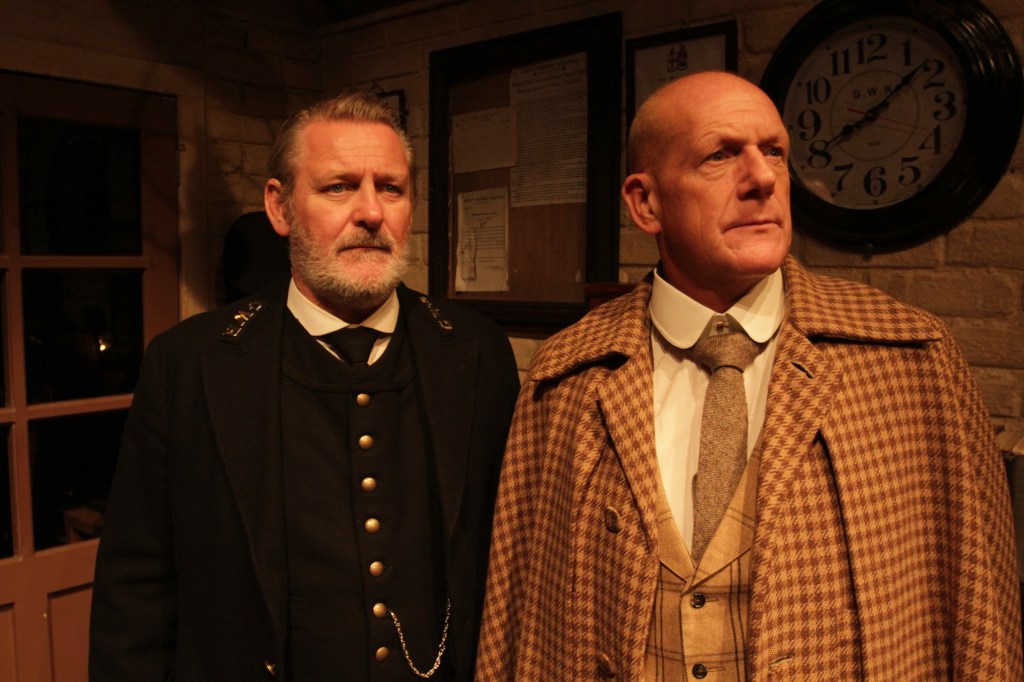
Signalman, Chris Walker and Traveller, John Burton, in the Victorian version of an anorak.
The first act involves the Traveller, whose back story has been embellished to balance the two characters’ parts, who relates a ghostly tale from his time as a coffee importer. He was in Brazil looking for a way to expand one of his coffee plantations, when he was confronted by a tribe trying to frighten his party off the land by invoking the power of a spirit. The monster, a huge man with one great eye and a mouth in his abdomen, was duly shot by one of the Traveller’s companions, only to be revealed as a mortal in elaborate costume, walking on stilts.
As the evening progressed and the two men became better acquainted, both with each other and, in the Traveller’s case, the operation of the signal box. The stranger asked if he may return the following night to hear the Signalman’s ghostly story, which he had mentioned earlier, triggering the Brazilian tale. The Traveller went back to his hotel, had supper and wrote some letters.
The second act returned to the plot of the book and the Signalman’s plight.
It began with the Signalman seeing an apparition in the tunnel and, on going back into his box, the door of a cupboard opening and closing on its own account, and objects falling from the shelf.
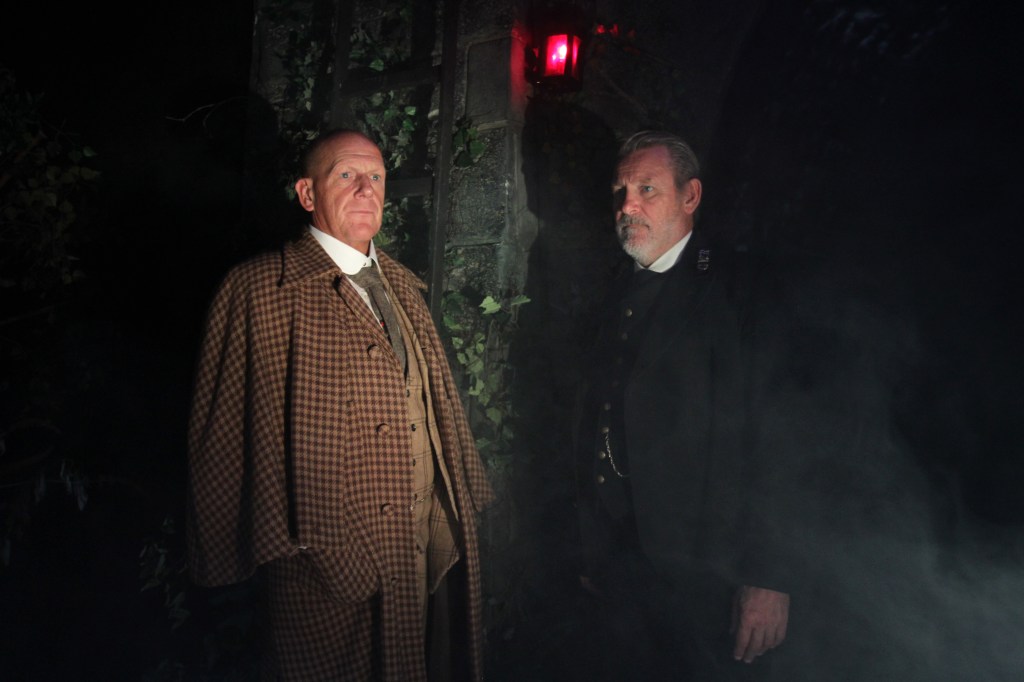
The Traveller and The Signalman meet outside the tunnel.
When the Traveller arrived, bearing fruit cake from the inn – well, HobNobs hadn’t been invented then – the pair sat down to tea and the yarn was spun. the Signalman told his companion that he had twice been witness to a ghostly figure, whom he could not identify as it had its arm across its face. Shortly after each vision, there had been an accident at the site. The first involved a crash in the tunnel and the second, the death of a beautiful woman on the line. He went on to say that he had seen the same ghostly figure for a third time earlier in the evening.
The Traveller discounted the sequence of events as coincidence and suggested the Signalman consult one of his friends, a neurologist, who lived quite close by. After much persuasion it was agreed that an appointment would be made.
I will leave it there as I don’t want to spoil the ending, should you go see it. If it is not visiting a theatre near you, then it won’t take you long to read the book to find out what happened.
It might sound as though it was intense, but there were a couple of amusing interludes. Normally in these situations, they are strategically placed to provide contrast just before some horrendous act, but here they seemed to be randomly inserted.
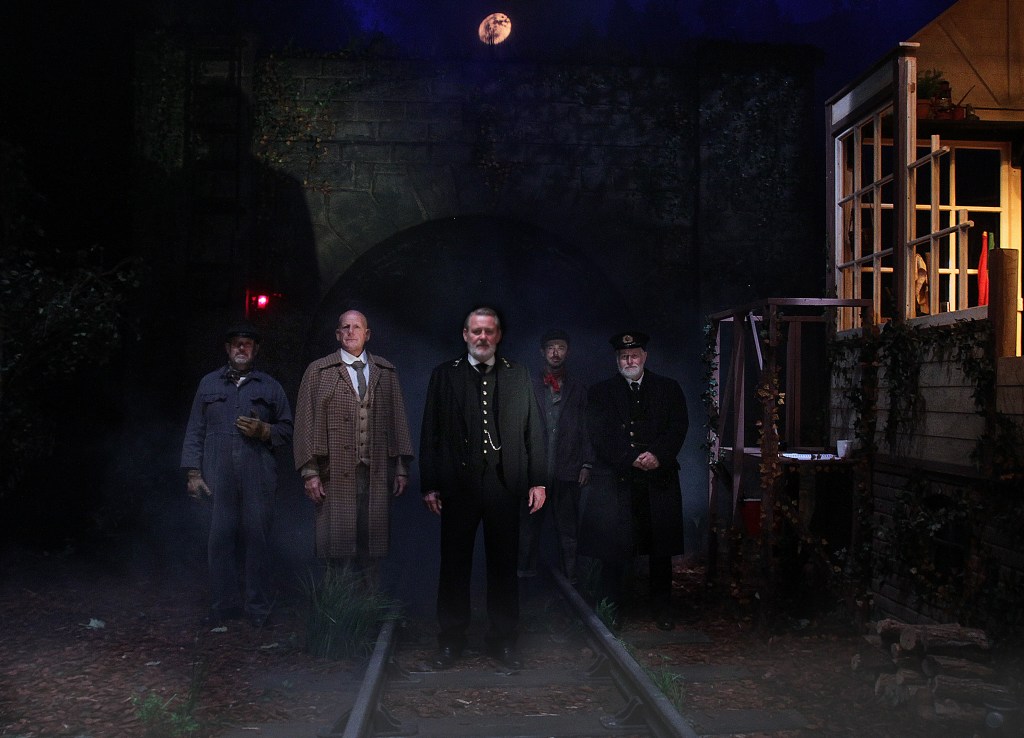
The cast outside the signal box. Please don’t pose for photographs on railway lines children, not even for TikTok clicks!
The set was very good, with a mock-up tunnel to one side and the signal box on the other, having an open front to show the confined space and mechanics within. The Director and Designer, Michael Lunney, must be a fellow Yorkshireman as he certainly got his money’s worth from the smoke machine; I was sitting at the back of the auditorium and it reached me. The Lighting Design by Bob Hodges did the trick with the use of lanterns for the exterior scenes and flickering lights within the box. In spite of all this, the overall effect, although sombre, didn’t exactly put me in mortal fear.
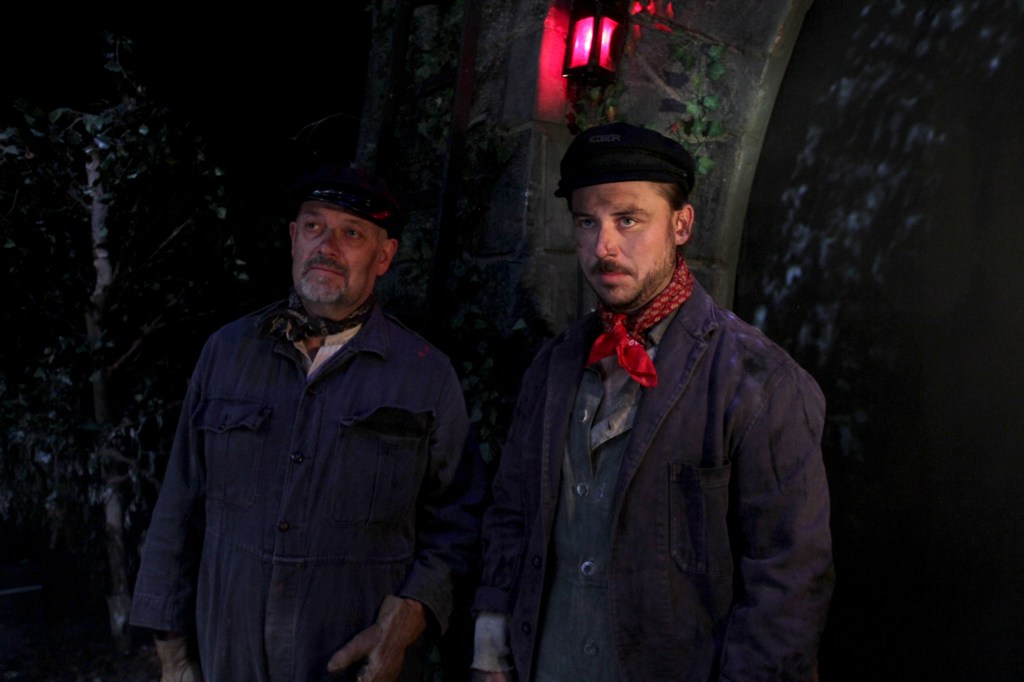
Bruce Chattan, as a railway worker (he also played The Innkeeper) and Adam Mort, Tom.
The play was basically a two-hander with Chris Walker as The Stationmaster and John Burton as The Traveller, although there were appearances by Bruce Chattan as The Innkeeper, James Morley as The Inspector and Adam Mort (French for dead – very appropriate) as Tom. I did find Mr Walker a bit difficult to hear at times, as did a couple of other theatregoers I spoke with, but, on the whole the acting from all concerned was excellent.
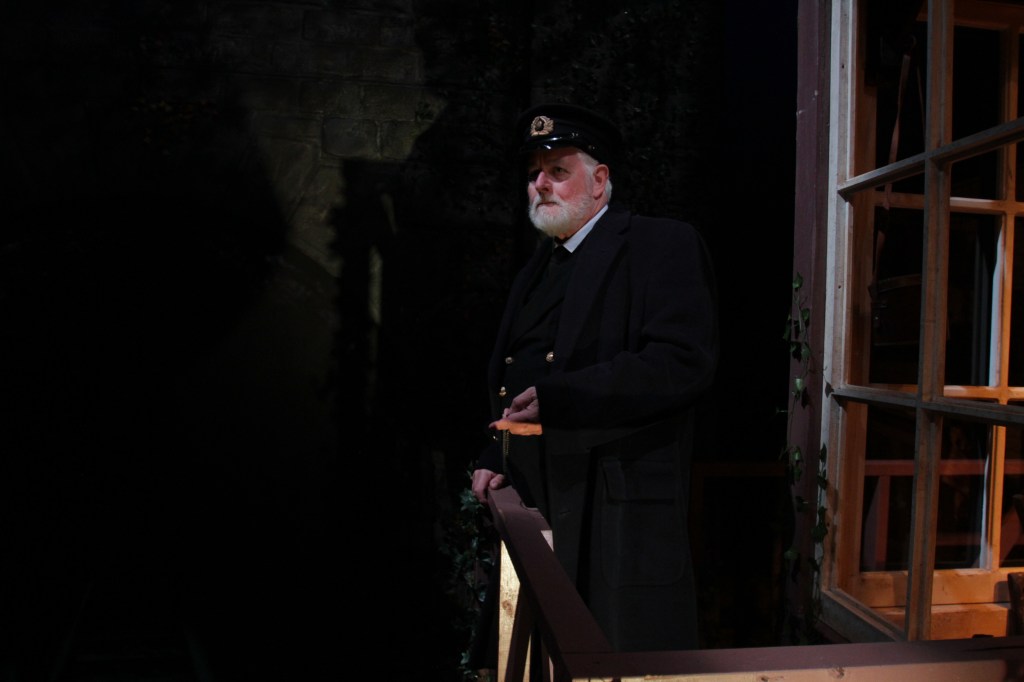
James Morley as the Inspector
The denouement is more cerebral than scary, and the twist could be seen coming all the way from King’s Cross, but it was a very good night out and, if it did jangle your nerves, the early finish meant there was plenty of time to get a large brandy from one of the local bars.
For more information, and to book, please go to https://www.harrogatetheatre.co.uk/events/the-signalman/ where you can also find details of a special offer should you wish to see all three of the plays in the Harrogate Theatre Drama Series. The other two are Black Tie Ball by John Godber from 10th – 13th September and Bedroom Farce by Alan Ayckbourn on 16th – 20th September.
Full details of all upcoming shows at the various venues in Harrogate are at https://www.harrogatetheatre.co.uk/whats-on/
For more information about Middle Ground Theatre Company, including further tour dates, it is http://www.middlegroundtheatre.co.uk/Wordpress/
 Tyke It To The Limit